
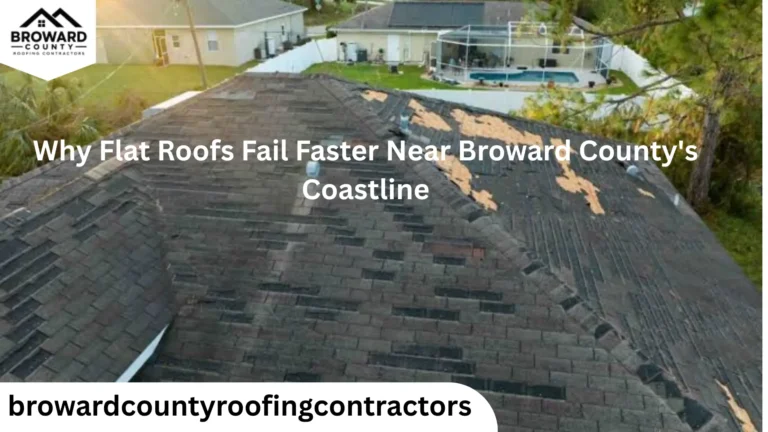
Last week a homeowner told us, “I figured a roof would outlast me.” It was a flat one, about nine years old, a short walk from the water. It had two patches already and a brown stain over the bed.
We had to break the news. That roof wasn’t unlucky. It was just in the wrong place for a flat roof, or at least a place that asks a lot more of one.
So if you’ve got a flat roof near the Broward coastline, and it seems to need more attention than your neighbor’s pitched roof, this one’s for you. We’re Broward County Roofing Contractors. We’ll tell you what’s going on up there, in plain words.
Flat Roofs Have Less Wiggle Room
Here’s the basic problem. A pitched roof lets gravity do the work. Rain runs off and that’s that.
The slope on a flat roof is very small because it does not incline much to direct the water to the drains or the opening in the parapet wall. It’s more like a baking tray than a mountain. In case everything goes well, that’s fine. But in case one drain gets blocked, there is no escape route for water.
Lots of Broward buildings use them. Porches, add-on rooms, modern houses, little shops, apartment buildings. In mild places, they do fine. Near the ocean, they’ve got a rougher job.
The Salt Problem
You can’t see it, but the breeze off the water is full of salt. It drifts onto roofs and sticks. Salt and metal get along about as well as cats and baths.
And a flat roof has more metal on it than most people realize.
- The metal strip around the edge
- Flashing, which is the thin metal at pipes, vents and walls
- Screws and plates that hold the roof down
- Drain covers
- Brackets under air conditioners
These bits sit right where water tries to sneak in. So when they rust, the leaks start. We’ve climbed onto roofs that looked perfect in the middle with edges that were barely there.
Rain washes some of the salt off. Not all of it, though. Corners and sheltered spots stay dry, and the salt just piles up and holds moisture against the metal.
Sun, Heat and Stiff Seams
Nothing shades a flat roof. It sits flat to the sun from breakfast till dinner. In July, you could fry something on it. Not that we’d recommend it.
The roof material swells a bit in the heat and shrinks at night. Do that every day for ten years, and something has to give. The seams go stiff. The surface turns chalky. Tiny cracks start up and slowly open.
A lighter color helps. It reflects more sun, so the roof stays cooler and ages a little slower.
Water That Sticks Around
This is the one we see most.
Our summer rain doesn’t drizzle. It dumps. A flat roof has to push all of it to the drains in a hurry, and when a drain is blocked, the roof just fills up.
A puddle that’s gone by tomorrow is nothing to worry about. A puddle that’s still there two days later is. Roofers call that ponding.
Why does it matter so much? Water weighs a lot, for one thing, so a pool can press the roof lower and make the dip worse. The sun heats that water, too. It also finds every little crack and seam, and in our humid air the layers below take forever to dry.
Under the top surface sits insulation. Once it’s wet, it can stay wet for months. Mold can show up. And water travels sideways inside the roof, so the ceiling stain might be a long way from the real leak. We’ve watched people patch the wrong spot three times in a row.
It is most often because the drain is blocked up. Leaves, sand, or a small piece of rubbish. It is not expensive to fix. It is easy to forget.
The Wind Has the Final Say
During a storm, the wind will go for the corners of a flat roof first. If the metal has been worn away by the salt, the wind will blow it up and start tearing the roof off.
Broward sits in the High Velocity Hurricane Zone, so edges and fasteners have to meet tough code rules when a roof is built. But rusty screws don’t hold like new ones. That’s the part people forget.
All Four at Once
None of these works alone. They gang up. Here’s how it looks side by side.
| What It Is | What It Does | Where You See It |
| Salty breeze | Rusts metal parts | Edges, screws, flashing, drain covers |
| Strong sun | Dries out and cracks the surface | Seams and top layer |
| Standing water | Soaks the layers and adds weight | Low spots, and inside the roof |
| Storm wind | Lifts weak edges | Corners and borders |
Rust opens a gap. The sun cracks the surface. Water gets in. Wind finishes the job in the next storm. In our experience, a coastal flat roof often needs help several years before one inland.
Inland Roofs Get an Easier Ride
A flat roof a few miles from the water still deals with sun and rain. That part is the same. What it doesn’t get is the salty mist, and the rougher wind that comes with an open shoreline.
Without salt eating at the metal, edges and screws hold up longer. And when the edges hold, the whole roof tends to hold. That’s the big reason two roofs of the same age and the same material can end up in such different shape.
It doesn’t mean an inland roof can be ignored. It just means a coastal roof has one more enemy, and a quiet one.
Signs Worth a Look
You don’t have to climb up for most of this. Look from a window after rain.
- Water still sitting on the roof a day or two later
- Bumps or bubbles
- Cracks along the seams
- Rust streaks on the wall below the roof
- Edge metal that’s bent or lifting
- A faded, rough or powdery surface
- New ceiling stains or a musty smell
And do not go on the roof if it is wet because it is slippery and could cause more harm to the roof by stepping on a weak spot. Leave the inspection of the roof to professionals.
Easy Maintenance
No one likes doing maintenance, so this is a brief list.
- Before June: have your roof inspected and all drains cleaned.
- Following a big storm: check for puddles, flaps, and stains. Take photographs.
- Every few months: hose down the metal edges and vents.
- Once a year, trim the branches and have a pro check the seams
Don’t use a pressure washer. It can force water under the seams. And before you put a new AC unit or a deck up there, call us. Extra weight makes low spots worse.
What Waiting Costs
We get it. Roofs aren’t fun to spend money on, and a small stain is easy to put off. But on a flat roof, waiting is rarely free.
A small leak lets water into the insulation. Wet insulation spreads. Soon a repair that would have been small turns into a bigger one, because now the wet layers have to come out too. Mold can follow, and mold inside a ceiling is no fun for anyone.
The cheapest day to fix a roof is almost always today. We say that even though it’s our line of work, because it’s true.
Patch, Coat or Redo
Not every leak means a new roof. The first thing we always consider is in three categories.
Patch it up if the damage is minor and the materials beneath are still dry. It is typical for split seams and problem areas near pipes.
Coat it if the roof is sound but the top is tired. A good reflective coating can add years and cool things off. It won’t save a roof with wet insulation or lots of blisters. Coating over a problem just hides it.
Redo it if the layers are soaked, the damage is everywhere or the same leak keeps coming back. Past that point you’re just paying to delay the bill.
We use moisture checks to tell which one you’re dealing with. They show wet areas you can’t see from above, so you don’t pay for the wrong fix.
Insurance, Briefly
The majority of insurance policies will take care of damage caused by storms. However, age-related damage, which occurs more slowly, may be handled in another manner. All insurance policies are unique, so make sure to talk to your agent. And don’t forget to keep your records.
How We Do a Flat Roof
Many early failures near the coast come from rushed work or cheap parts. A careful job runs like this.
We start with an inspection and a moisture check. Next comes the permit, since roof work in Broward needs one and gets inspected. The old roofing comes off, along with any wet or rotten layers. In case the roof is not draining well, then we construct a slope using tapered insulation. Tapered insulation entails cutting foam into wedges to direct water flow towards the drainage point.
We lay the roof membrane after that and test for seams. We choose edge metal, flashing and screws that can handle salt. Drains get checked for size and spot. Last, the inspector signs off.
Picking Your Roofer
Find out what type of metal will be used on the edges. Find out how they are going to take care of the drainage and seam testing. Check what their warranty entails on roofs that are located in proximity to the water as there is always a limit. Ask to see their license and check their insurance.
What We Offer
Broward County Roofing Contractors works on flat roofs across the whole county. For this topic, that means flat roof inspections, moisture checks, leak repair, drain and flashing repair, new edge metal, coatings and full flat roof replacement. We also help with permits and storm damage repair.
If a small fix will do, we’ll say so. If you need more, we’ll show you what we found and why, and you decide.
FAQs
Why does my flat roof only leak when it rains hard?
A tiny opening in the seam or edge can remain dry in light rain. Harder rain brings more water and pressure and forces its way through. The opening exists even when the weather is dry.
Is a small bubble anything serious?
It can be. It typically indicates moisture and air that have found their way into your roof. It should be fixed before the opening cracks.
Does roof rinsing work?
Sure, it does. A careful washing of the metal components removes salt from the surface. A regular hose is recommended, but not a pressure washer.
Can I install an AC unit or a deck on my flat roof?
Occasionally. Your roof needs to support the load and all added structures need proper flashing installed. Better consult a professional first, or else your warranty will be voided and low spots created.
How much does flat roof repair cost?
This is dependent on the extent of damage, type of roofing, amount of water penetration and accessibility of the roof. We can give you a reasonable estimate after inspection.
How fast should I act on a leak?
Right away. Water moves sideways under the surface and soaks the layers. Even a temporary fix beats waiting.
Wrapping Up
The flat roof that is situated close to the Broward shoreline faces salty winds, intense sunlight, clogged drainage systems and storm winds at once. No big deal. The roof will deteriorate faster than people expect. The good news is that it does so gradually, giving people enough time to take action.
Keep the drainage system clean and inspect the corners of the roof regularly. Not sure how your roof is holding up? Broward County Roofing Contractors will take a look and tell you what we see, in plain words, and help you decide what comes next.

- Why Clogged Drains in Flat Roof Systems Cause Major Damage - October 23, 2026
- Why Flat Roofs Fail Faster Near Broward County’s Coastline - October 21, 2026
- TPO or EPDM for Your Broward Business Roof? Let’s Sort It Out - October 20, 2026