
A roof drain is about the size of a dinner plate. It’s cheap, it’s easy to forget, and on a flat roof it decides a lot. When it works, nobody thinks about it. When it doesn’t, the bill can land in the thousands.
Clogged drains on flat roofs are one of the most common reasons we get called out. They’re also one of the most avoidable. The problem usually starts with a handful of leaves and ends with a stained ceiling, a soaked building or worse.
We are Broward County Roofing Contractors and have cleared numerous drains of numerous clogs. Below is a description of how drain blockages occur, their effects on the building, and how to avoid them in your building.
Drainage of a Flat Roof
A flat roof has a slight slope. Rain runs along it toward an outlet and leaves. There are a few kinds of outlets, and you may have more than one.
- Interior drains, which sit in the middle of the roof and send water down pipes inside the walls
- Scuppers, which are openings cut through the edge wall so water can spill out
- Gutters and downspouts along the roof edge
- Overflow outlets, set a bit higher as a backup if the main drain gets blocked
That last one is easy to miss. Many roofs have overflow openings that only come into play when something has already gone wrong. If water is leaving through them, the main drain isn’t doing its job.
Every one of these has the same weakness. They’re small, and they sit at the lowest point of the roof, which is exactly where everything washes to.
What Plugs Them Up
Almost anything that blows onto a roof ends up in a drain. Here in Broward, the usual suspects are these.
- Leaves and seed pods from nearby trees
- Palm fronds and bits of bark
- Sand and grit, especially after a storm
- Loose roofing granules and bits of old sealant
- Trash, plastic bags and bottle caps
- Bird nests and feathers
- Leftover materials from past repairs
Sand surprises people. It doesn’t look like much, but it packs into a drain like cement, especially once it gets wet.
A clog also doesn’t have to be at the top. Sometimes the cover is clear and the pipe underneath is blocked. The roof looks fine, yet the water still isn’t leaving. We’ve seen that more times than we can count.
The Chain Reaction
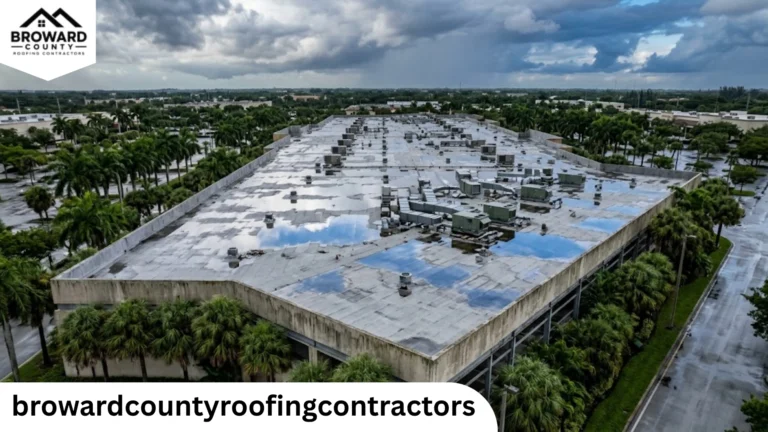
Here’s how a small clog turns into a big problem. It usually goes in order. To start, it rains, and the drain is unable to cope with it. Water gathers on the surface and forms a thin pond. After that, the pond stays there for a while.
The standing water will enter the vulnerable areas and move deeper through the seams, cracks, or deteriorated pieces of flashing. After that, it gets inside the insulation beneath, which behaves like a sponge. This layer will keep the water for quite a while.
Finally, the water starts moving by the force of gravity downwards and gets down to the deck, ceiling, and then through the floor in the living space below. It takes weeks of the water moving before a stain is observed. Every step is connected to the previous one. And the first step, the clog, was free to fix.
The Weight You Can’t See
People forget that water is heavy. One inch across a square foot weighs about five pounds. When we talk about a roof of 1000 square feet, we are talking about thousands of pounds that the roof cannot sustain for a long period of time.
There is capacity in a roof deck to withstand some loads, but a drain clogged for several storms will make the roof deck sustain these weights many times. The lowest point will be even more lowered due to the additional water pressure.
Real collapses are rare. When they do happen, a blocked drain is often part of the story. That’s why engineers take drainage seriously, and why we do too.
Damage Inside the Building
Roof damage isn’t just a roof problem. Once water gets in, it can reach nearly everything inside.
- Stained and sagging ceilings
- Wet walls and peeling paint
- Mold in hidden spaces
- Ruined insulation
- Soaked carpet and floors
- Water near wiring and light fixtures
That last one matters for safety. Water does not go with electricity. In case you notice any water around the lights or outlets, it is better to keep off and seek assistance.
When it comes to a business or a building, the costs will go up. The stock is damaged and there are complaints from tenants.
When Drains Back Up Inside
Interior drains hide a nasty trick. The pipes run through the walls, and if the line is blocked, water can back up the pipe and flood out at a weak joint.
Sometimes it shows up as a damp wall in a closet or a stain high up on a wall. It’s easy to blame the wrong thing. We usually check the drain line as part of any investigation for that reason.
Drain Parts at a Glance
This table shows the usual drain parts, what clogs them and what you may notice.
| Drain Part | What Blocks It | Warning Sign |
| Interior drain | Leaves, sand, trash in the bowl or pipe | Water stays around the drain after rain |
| Scupper | Debris, a crushed or narrowed opening | Water pools behind the edge wall |
| Gutter and downspout | Leaves, seed pods, nests | Overflow, stains on the wall below |
| Overflow outlet | Dirt, paint, old sealant | Water leaves here when it shouldn’t |
| Drain pipe below the roof | Sand, roots, collapsed section | Slow drain even with a clean cover |
Early Warning Signs
The earlier you catch a clog, the cheaper it is. Walk around after rain, and again the next day. Look for these.
- Puddles near drains that haven’t dried by the next day
- Stains or streaks on exterior walls below a scupper
- Gutters overflowing in steady rain
- A gurgling or slow-draining sound from the downspout
- Water marks on a ceiling beneath the roof
If you can see the roof from a window or a second floor, that’s all you need. Stay off the roof when it’s wet.
Storm Season Raises the Stakes
Broward gets heavy rain, and in the summer it comes in bursts. A roof can take in a year’s worth of small clogs and not complain. Then one big storm hits and the drains have to move a huge amount of water in minutes.
Storms cause the clogs to worsen as well. Wind blows leaves, branches, and other debris onto the roof. Following a hurricane, our clients commonly find that their drains are clogged completely. For this reason, we recommend clearing them prior to the beginning of the season, as well as after the end of each storm. Roofs near the water have it even harder, which we explain in our post on why flat roofs fail faster near the coastline.
A Cleaning Schedule That Works
Flat roofs usually require several simple maintenance inspections which do not take much time.
Clear the drains and scuppers prior to June. Repeat this in autumn, as well as following each storm. Wearing gloves and carrying a bucket is necessary because you will be removing wet debris. Ensure the proper placement of the drain cover or strainer and avoid putting leaves into the drainpipe.
After completing the cleaning, pour a bucket or use a hose in the area. Water should flow towards the drain and vanish. If it’s slow, there’s likely a clog farther down.
Only do this if the roof is safely reachable and dry. If it’s not, call a roofer. A fall isn’t worth saving a service call.
When a Pro Should Step In
Some jobs go beyond a scoop and a bucket. Call a roofer when:
- The drain stays slow after you clean it
- Water backs up even with a clear cover
- You see stains inside or sagging near a drain
- The drain cover is cracked or missing
- The roof has no overflow outlet
In those cases, we flush the line, and if needed, run a camera through the pipe to see what’s blocking it. We can also test the roof by running water across it to see how it drains.
What a Drain Check Involves
What exactly do we do on the visit? Well, that is the short answer. First of all, we inspect the roof, take pictures of all drains, scuppers, and overflows and make notes of all blockages and damage.
After that, we clean up the debris and check the drainage using a garden hose. If the water flows fast enough – perfect. If not, we take a look into the pipes. After that, we tell you about the problems found and provide you with the pictures and a written estimate.
If necessary, you will know what should be done right away and what could wait.
It is highly recommended to ask your roofers to take some pictures before and after their work. They’re proof the work was done, and they’re helpful if an insurance question comes up.
Homes, Shops and Apartment Buildings
Drain problems look a little different depending on the building. A house with a flat porch roof might have only one scupper, and one clog will cover the entire roof. A store or an apartment building will have many drains, so one clog will be hidden by the others.
On bigger buildings, somebody needs to own the job. If the owner thinks the property manager checks the roof, and the manager thinks the owner does, nobody checks it. Put a date on the calendar, and put a name next to it. And if a shop or apartment building needs a new roof membrane, see how TPO and EPDM compare for Broward businesses.
Fixes That Help for Good
Cleaning solves today’s problem. A few changes can help prevent tomorrow’s. The dome-shaped strainer allows water inside but prevents debris from entering. Installation of the drain or the second scupper is helpful in case the roof is receiving too much water at one place. If the roof is sloping towards the drain, the tapered insulation can form the slope. And a missing overflow can be added.
Some changes need a permit. Roof and drain work in Broward County goes through the building office, and we handle that.
Insurance Related Issues
It will certainly get your attention. In general, insurance companies tend to include sudden and accidental losses such as storm damage to the roof under the policy. The damage caused by a clogged drainage system might be seen as a maintenance matter that would not be included.
It is impossible for us to know what is written in your insurance policy. Your agent will know for sure. We can only tell you that maintaining basic documentation does help prove that you maintained the roof.
What Does Our Company Do
Broward County Roofing Contractors helps flat roof owners across the whole county with drain inspections, cleaning, drain and scupper repair, new strainers, added drains and overflow outlets, tapered insulation, leak repair and, when the roof is past saving, roof replacement. We take care of the permits too.
Sometimes all a roof needs is a cleanout. When it needs more, you’ll see the photos before you decide.
FAQs
How often should flat roof drains be cleaned?
At least twice a year, and after any major storm. Roofs near trees may need it more often.
Can a clogged roof drain really cause a collapse?
It’s rare, but it can happen. Heavy standing water can overload a weak or aging roof deck. That’s why drains should never be ignored.
How do you distinguish a drain from a scupper?
The drain runs across the roof and discharges into a pipe. The scupper refers to an opening on the edge wall allowing water to run out from the side.
Is drain damage covered by insurance?
Not necessarily. Most policies do not cover damage arising from poor maintenance. Consult your insurance agent for more information.
Why do drains clog up again immediately after being cleaned?
This could be due to the location of the clog, which may be farther away from the drain or even caused by the presence of trees around the drain.
Are drain strainers effective?
Yes. Drain strainers ensure that larger pieces of debris do not enter the drain.
Check One Thing This Week
If you do nothing else after reading this, do one thing. Next time it rains, look at your roof’s drains the following morning. If there’s still water around them, you’ve found a problem worth fixing.
A clogged drain is easy to ignore and expensive to forget. If you’re not sure about yours, Broward County Roofing Contractors can come out, check the drains and tell you what we find.

- Why Clogged Drains in Flat Roof Systems Cause Major Damage - October 23, 2026
- Why Flat Roofs Fail Faster Near Broward County’s Coastline - October 21, 2026
- TPO or EPDM for Your Broward Business Roof? Let’s Sort It Out - October 20, 2026