
Water is heavier than most people think. Pour one inch of it across a square foot and you’re holding about five pounds. Think about an inch of snow resting on top of a roof covering 1,000 square feet. It would weigh approximately 5,000 pounds – more than a small car. Now picture it staying there for a week.
That’s ponding, and we run into it a lot at Broward County Roofing Contractors. Below, we will explain the reason for this occurrence in flat roofs, its consequences when it is left unchecked, and the typical way to solve it. Jargon-free, guaranteed.
What Ponding Really Means
After any rain, a flat roof will hold a few wet patches for a while. That’s fine. Ponding is different. It’s water that’s still sitting there a day or two after the sky has cleared.
It doesn’t need to be deep. A thin puddle that spreads over a big area and never dries can do real harm. In Broward, where another storm can roll in the next afternoon, a roof that holds water barely gets a chance to dry out.
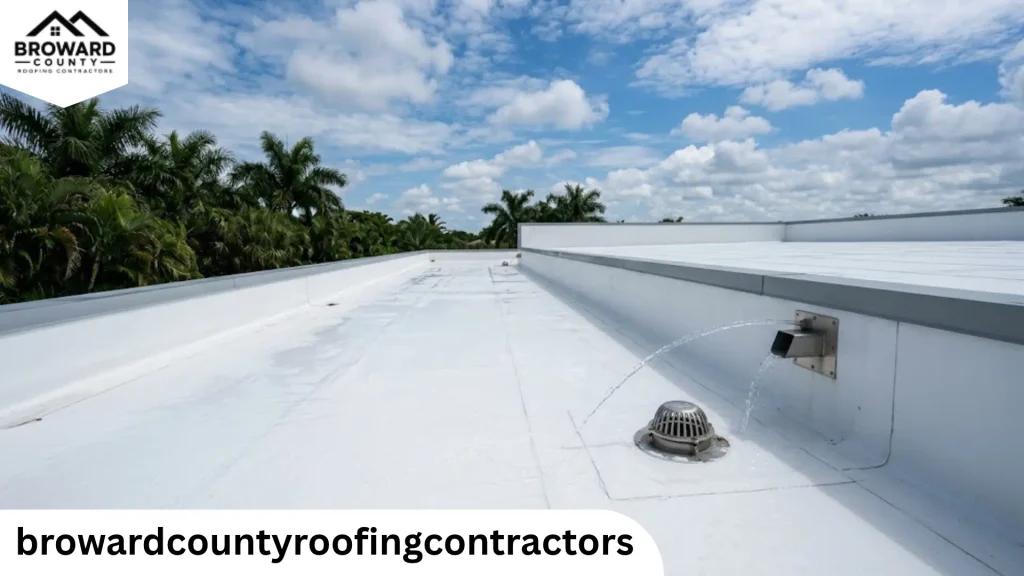
As a matter of fact, a flat roof is never truly flat. It is sloped to allow rainwater to drain into a drain or an opening in the side wall. A common pitch is about a quarter of an inch per foot, but that may vary depending on the roof construction.
Why Does the Water Stay?
In most cases, it is caused by one of the few things, or even a combination of several of them. The first reason why ponding occurs is a clogged drain. Leaves, sand, bits of trash, even an old bird’s nest can plug the opening. Water can’t leave, so it spreads.
Then there’s slope, or the lack of it. Some roofs were built too level to begin with. We see that on older buildings and on add-on rooms that got tacked on later. Roofs also sag. Over the years the deck can dip a little, or the insulation can get squashed in one place. Now you’ve got a shallow bowl, and bowls hold water.
The drainage can also be located at the wrong position. For instance, when a drainage is positioned higher than the surrounding roofs, water will circulate around it without draining in it. Further, a large roof with one or two drainage facilities cannot handle rainfall in Florida.
Equipment poses a hindrance. An air conditioner, a vent stack or even a wall can obstruct the course of water flow. In addition, a repair conducted some years back is a barrier too. A lump of sealant acts as a small dam.
A roof can be functional for several years but after that start ponding. This is because of settling, weight and drainage issues.
Why Broward Roofs Pond More
Our weather isn’t doing anyone favors. In summer, storms show up almost every afternoon, and some dump a lot of rain in a short time. A flat roof has to move all of it fast. If the drains are even a little slow, the roof fills before it can empty.
Humidity makes it worse. A puddle that would dry in a day in a dry place can hang around much longer here, since the air already holds so much moisture.
And then there are the trees. Leaves and seed pods drop on roofs all year. The first big storm of the season sends a pile of them straight into the drains. A lot of roofs that start ponding in June are really just victims of one clogged drain nobody looked at.
Heavy Water, Quiet Strain
Back to the weight. A roof is built to carry a certain load, and standing water adds to it. It adds the most in the exact spot where the roof is already weakest.
See the loop? The low spot holds water. The water pushes the spot lower. The deeper dip holds more water.
A few puddles won’t bring a roof down. But a roof that’s been loaded for years can wear out its deck and support early. In bad cases, the building needs structural work. That’s rare, and we’d like to keep it that way.
What Standing Water Does
The weight is only part of the story. Leaks come first. Water will find every crack and crevice that exists, and the puddle gets a whole day to do just that. Water will also get heated by the sun and cook the roof’s surface. That patch ages faster than the dry areas around it.
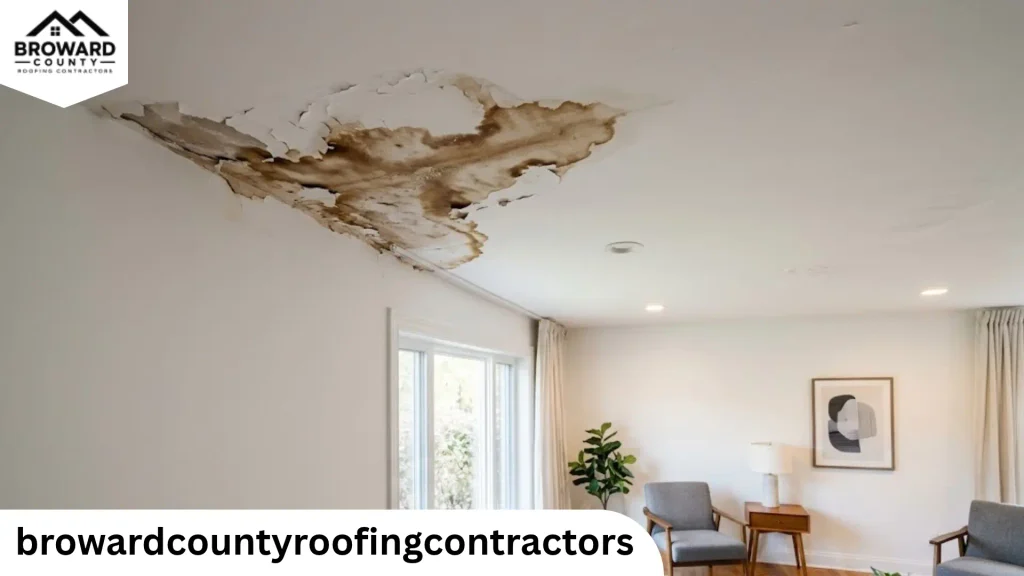
Then there’s the insulation under the roof. It becomes useless once it is wet and in the moist environment we have, it may remain wet for several months. Mold can grow from it, and it can affect the ceiling beneath.
To make matters worse, dirt will collect within it, and weeds can grow from it. Their roots can open the surface. And standing water lets mosquitoes breed in a matter of days, which matters a lot in this part of Florida. Add it all up and one little pond can turn into a big bill.
Finding the Real Cause
Every roof tells a story, and our job is to read it. The table shows the usual clues and the way each cause is normally fixed.
| Cause | How It Shows | Usual Fix |
| Clogged drain | Water stuck near a drain, debris in sight | Clean out and test the drain |
| Too little slope | Several puddles across a level area | Add tapered insulation |
| Sagging deck | A bowl-shaped dip, sometimes soft underfoot | Repair the deck, then rebuild the slope |
| Raised drain | Water ringing around the drain | Lower or replace the drain |
| Blocked path | A puddle behind equipment or a wall | Add a small ridge to steer water |
| Not enough drains | Slow draining on a large roof | Add drains or edge openings |
Only one of those is a cleaning job. The rest need actual roof work.
Spotting It From Below
You don’t need to be on the roof. After it rains, and again a day or two later, look for the following.
- Water still on the roof after two days
- Rings or stains where puddles used to be
- Dark streaks or green patches in the same spots
- Brown marks on ceilings below
- A musty smell indoors
A word of caution: don’t go up there while it’s wet. One wrong step on a soft patch can end badly.
Fixes That Work
The right repair depends on the cause. Here’s what we turn to most, roughly in order. Drains first. We clean them and we also make sure that there isn’t any clog in the underground pipes. It’s the easiest solution but it solves a lot of problems.
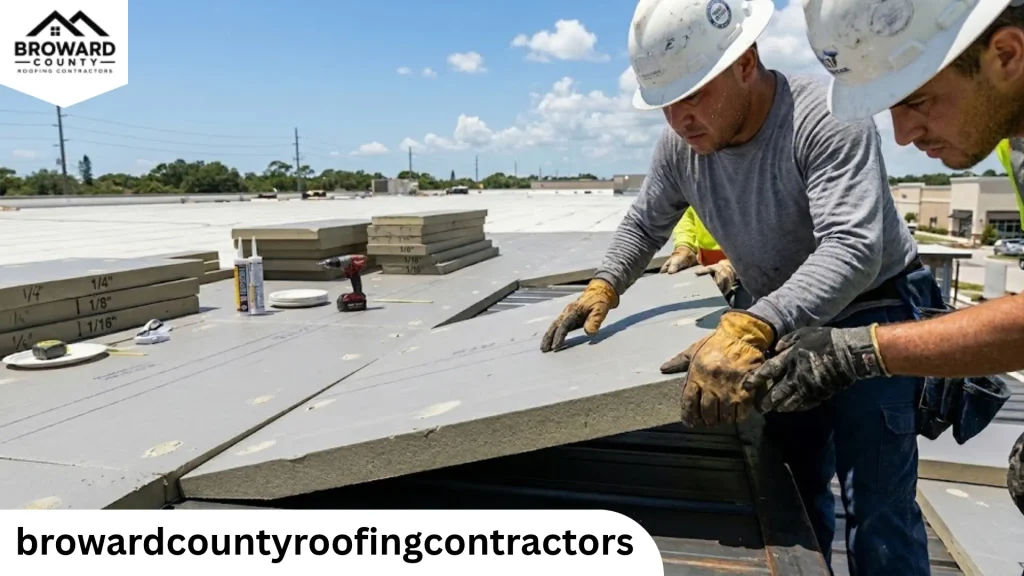
If the roof has no slope, we add tapered insulation. That’s foam cut in wedges. Laid under a new TPO or EPDM roof surface, it builds the tilt the roof should have had all along. For many roofs, it’s the best long-term answer.
In case the machine blocks the way, a cricket is formed. This is a small peaked structure through which water flows to reach the drain.
If the roof can’t drain well even with clean drains, we add more of them or put in openings at the edge. We can also lower drains that sit too high. And if the roof has sagged, the weak area has to be repaired before anything else. Covering it up won’t work.
Finally, where the surface under a puddle is damaged, we repair or replace it, and any soaked insulation under it has to come out.
Fixes That Don’t
We see a few shortcuts all the time, and none of them last. Smearing sealant over a damaged spot is the big one. It may stop a leak for a few weeks. Then water finds another way in, because the puddle never left.
Coating the whole roof is another. Coatings do not affect the slope; they only protect the surface. If the coating is applied to a sloped roof, any ponding will remain. And sweeping water off with a squeegee every few days? That’s a chore, not a fix.
What Repair Day Looks Like
We start with an inspection. We mark where water sits, check the drains and scan the layers below for moisture. That shows us what’s wet and how far it goes. Then we explain what we found and lay out the choices. Sometimes it’s a drain fix and a small repair. Sometimes it’s a section of new roof with built-up slope.
Roof work in Broward needs a permit, and we take care of that. The roof is then tested by checking how it will drain when there is rain. This timing differs depending on the job. Simple jobs such as drainage and minor repairs can be done within one or two days.
Large projects involving roof sloping may take time depending on the size of the roof and the weather. Afternoon storms can pause things. That’s just life in Broward.
The goal isn’t a pretty roof. It’s one where the water leaves.
Keeping It From Returning
A little upkeep goes a long way.
- Clear the drains before hurricane season and after big storms
- Trim trees that drop leaves on the roof
- Keep equipment from blocking water paths
- Schedule a roof maintenance check once a year
- Take care of small low spots before they become bigger
Make sure to consult a professional before putting any weight on top of the roof as the new installation may affect water flow.
Warranty and Insurance
Not many homeowners are aware of this one. There are some roofing manufacturers that void warranty in case there is ponding on the roof. It is good to make sure.
Insurance becomes an issue as well. Most policies provide coverage for sudden events only, but not negligence. Roof with ponding for a long time period will be a gray zone. Keep good documentation of your roof maintenance and consult with your insurance agent.
How to Choose a Roofer
Ask a roofer what approach he uses to locate the problem. If you hear just “We will patch it”, keep searching. You need to know if they will check the insulation for moisture, correct the slope, and how they will check the results.
How We Can Help
Our team specializes in flat roof repair in Broward County. As for ponding problems, we can inspect the roof, clean, repair, add or relocate the drainage system, install tapered insulation, repair the roof surface, and eliminate leaks. If the roof is past saving, we handle a complete replacement too. Permits and storm repairs are part of the service. If it’s a small fix, we’ll say so. If it’s bigger, we’ll show you why.
FAQs
How long is too long for water to sit on a flat roof?
A day or two after rain is the usual line. Water that stays longer than that should be looked at.
Can mosquitoes breed on my roof?
Yes. Standing water lets them breed in a few days. That’s one more reason to get ponding fixed.
Will a coating stop ponding?
No. While the paint acts as a protective layer, it will not alter the slope. The low areas have to be corrected.
Do I Need More Drains?
Possibly. When an area with a big roof drains slowly despite cleaning the drains, adding more drains or edge vents would be helpful. Inspection would give you the answers.
Does Ponding Void My Warranty?
It could. Some warranties do not cover damage done by standing water. Check yours or contact the manufacturer.
Can I Correct Ponding Myself?
I can clear the accessible drains from any leaves. However, correcting the slope, drain problem or repairing the roof requires professional attention. Do not walk on wet roofs.
Final Thoughts
At first sight, ponding appears harmless – water on the roof. However, water is heavy, persistent and tends to find its way into any weak spots. The damage happens when the water stays.
The good news is that this problem is correctable. One just has to establish the source, correct the slope or the drain problem and maintain the roof. If there are stubborn puddles on your roof, Broward County Roofing Contractors would like to help you. You can request an estimate online to get started.