
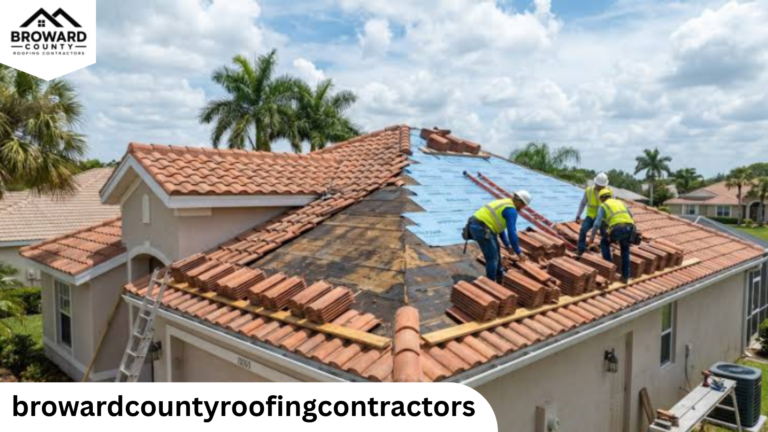
Walk around a neighborhood in Pembroke Pines or Coral Springs and you’ll see plenty of tile roofs that look great. Even color, no missing pieces. Owners tend to assume that means the roof is in good shape.
Sometimes it is. But a tile roof can look perfect and still be failing, because the tile isn’t the part that keeps your house dry. Water slips under tile all the time, especially when a summer storm drives rain sideways. What stops it from reaching your ceiling is the underlayment, a sheet of water-resistant material sitting on the roof deck underneath. If you’re thinking about tile roof underlayment replacement in Florida, or just wondering whether you need it, this is what’s worth knowing.
The layer nobody sees
Picture a tile roof as two systems stacked together. The tile on top takes the sun, the wind, and most of the rain. The underlayment below catches whatever gets through and sends it down to the eaves.
You’ll usually run into one of three materials. Felt, which is asphalt-soaked paper, has been used for decades. Synthetic underlayment is made from polymers and tends to be lighter and tougher to tear. Self-adhered membranes are peel-and-stick sheets that stick to the deck and seal around the nails, and they’re popular in places where wind is a concern. None of these is automatically “best.” The right choice depends on your roof’s slope, the type of tile, the manufacturer’s requirements, and what local code allows. If a contractor can’t explain why they chose one for your roof, keep asking.
Why tile doesn’t make a roof waterproof
Tiles overlap and interlock, but there are gaps on purpose. That’s how the roof breathes and drains. The trade-off is that wind-blown rain can get underneath, and once it does, it runs across the underlayment looking for a way out.
The fasteners add another weak point. Whether your tiles are nailed, screwed, foamed, or set in mortar, something is usually going through that underlayment. Over the years the material around those holes gets tired.
Roofers who’ve lifted tile on older homes will tell you the same story. The tiles come up looking almost new, and the underlayment under them is brittle, cracked, or torn. From the driveway, nobody would have guessed.
What Broward’s weather does to it
South Florida is about as hard on a roof as it gets. Summer heat bakes the space under the tile, and some underlayment materials dry out and stiffen after enough years of it. Humidity never really lets up. Then hurricane season arrives and every valley, wall joint, and vent pipe gets tested.
Broward County also sits in Florida’s High-Velocity Hurricane Zone, which has tougher product and installation rules than most of the state. Those details change and can differ by city, so I won’t try to list them here. Ask your contractor to show you the product approvals and permit requirements for your specific address before anyone picks up a tool.
How to tell something’s wrong
Since you can’t see it, the clues are indirect. A ceiling stain that appears after a big rain, with no cracked tiles in sight, is a classic one. So is a musty smell in the attic, or decking that looks dark or damp when you shine a flashlight on it. If your roof is older and nobody has ever replaced what’s under the tile, that’s worth a look on its own. Tile commonly outlasts its underlayment. Constant patching and slipped tiles can also point to trouble underneath, and so can storm damage that only got a surface fix.
None of that proves the underlayment is to blame. Bad flashing, a cracked vent boot, or dried-out sealant can cause the same symptoms. That’s the reason to get someone up there to check instead of guessing.
What replacement involves

You can’t replace underlayment without taking the tile off, so this is a real project, not a quick repair.
A good crew starts with an inspection: attic, flashing, tile, and decking. Then the tile comes off and gets stacked carefully. Some pieces will break no matter how careful anyone is, so ask how replacements will be found and matched. With the old underlayment gone, the plywood deck is exposed, and any soft or rotted spots need to be fixed before moving on. Laying new material over bad decking defeats the purpose.
Next comes the new underlayment, installed per the manufacturer’s instructions and local requirements. It’s also the sensible moment to redo flashing at valleys, walls, chimneys, and anything poking through the roof, since that’s where leaks love to start. Then the tile goes back, fastened with an approved method for your system and your wind exposure. Roofing work in Broward generally involves a permit and inspections, so your contractor should be handling that and keeping you posted. Check current rules with your local building department.
Questions worth asking before you sign
Ask which underlayment they plan to use and why. Ask whether they’re replacing all of it or only part. Ask what happens if they find rotten decking or lots of broken tile halfway through, and whether flashing is included in the price. Find out who pulls the permit, and what the warranty covers, both from the contractor and from the manufacturer. Confirm they’re licensed and insured in Florida; the state’s online license lookup makes that easy.
Be wary of a quote given over the phone, or anyone who says new tile alone will fix a leak.
Repair, underlayment only, or full re-roof?
It depends on the roof. One leak on a fairly young roof might just need a flashing repair. If the underlayment is aging all over but the tile is sound, replacing the underlayment and reusing the tile often makes the most sense. If the tile itself is failing or the deck is in bad shape, a full re-roof may be the better move. Costs vary with roof size, slope, tile type, and deck condition, so ask for an itemized written estimate rather than relying on numbers from random websites.
After big storms, and now and then as the roof ages, it’s worth having it looked at. A small problem caught early is far cheaper than ruined insulation and drywall.
FAQs
How long does tile roof underlayment last in Florida?
It depends on the material, the installation, and how much heat and moisture it has lived through. It usually doesn’t last as long as the tile above it. A roofer can judge the condition of yours in person.
Can the underlayment be replaced without replacing the tile?
Usually, yes. The tile comes off, the underlayment is replaced, and the tile goes back. Expect a few broken pieces.
Is it the tile or the underlayment that keeps water out?
The underlayment. Tile protects it and handles most of the water, but it isn’t built to be waterproof alone.
Can I tell if a leak is from the underlayment?
Rarely, without an inspection. Flashing, vent boots, and cracked tile cause similar symptoms.
Do I need a permit in Broward County?
Roofing work typically does, but rules change and vary by city. Confirm with your building department, or get your contractor to confirm in writing.
Will insurance pay for it?
That depends on your policy and what caused the damage. Storm damage and age-related wear are often treated differently. Read your policy and call your agent.
What does it cost?
There’s no honest flat price. Size, pitch, tile type, decking condition, and materials all change it. Get a written estimate from a licensed contractor.
The short version
A tile roof can hide a worn-out waterproofing layer for years. In Broward’s heat and storm season, that layer works harder than anything else on your roof. If yours is getting older, leaks for no obvious reason, or has never had its underlayment checked, get it inspected.