
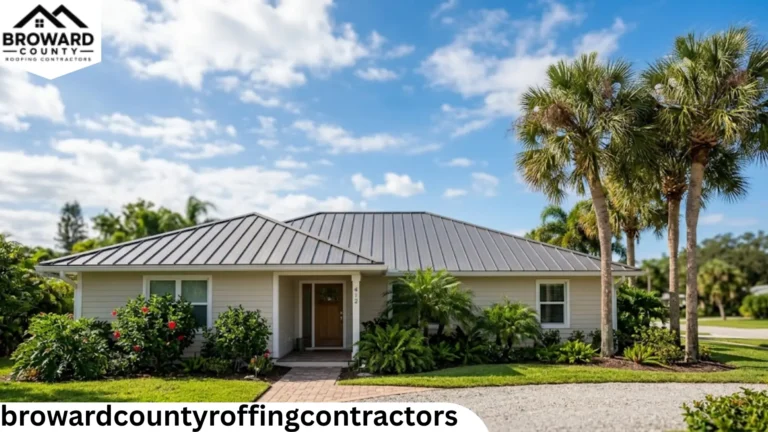
We did a job last spring that stuck with us. A homeowner had a metal roof put on eight years ago. Good material. Decent install. She had not touched it since the day the crew left. No inspection. No cleaning. Nothing. She called because a corner of her bedroom ceiling had gone soft. She could push her finger into the drywall.
Getting up on that roof felt like reading eight years of neglect. Three screws near the peak had risen so far the washers were not making contact anymore. A strip of sealant along the back wall had dried into something brittle and pulled away on both sides. Paint in two of the valleys had turned chalky grey from sitting under wet leaves season after season.
None of those things were expensive on their own. Together, they had caused enough water movement to damage her ceiling. That is the pattern we see on metal roofs across Broward County. Not one big dramatic failure. Just small things drifting in the wrong direction until someone notices a stain inside.
At Broward County Roofing Contractors, we handle metal roof inspection, repair, coating, installation, and replacement all across Broward County. This piece covers what actually needs looking at once a year — written the way we would explain it standing in your driveway.
Screws That Rise Without Anyone Noticing
Take a metal roof with exposed fasteners. Each screw holds a panel down and has a rubber washer under the head. That washer gets compressed when the screw goes in. The compression is the seal.
Here is the problem. Morning comes and the sun heats those panels. The metal stretches slightly. At night it cools and pulls back. The screw does not travel with the panel the same way.
Over months and years, the screw rides upward a tiny bit at a time. Nobody feels it. Nobody sees it from below. But the washer is getting less and less pressure until it is sealing nothing at all. Rain hits that panel, runs toward the screw, and finds an open path straight through.
When we do a metal roof inspection, we go along every panel run and physically test each fastener. Any that have risen get pressed back. Any with a flattened or cracked washer get replaced with a new screw and fresh washer.
Caught during a yearly visit, this is a straightforward metal roof repair. Left alone for another year or two, it is a stained ceiling and a bigger bill.
Sealant That Has Quietly Stopped Working
There are joints all over a metal roof that sealant is responsible for keeping closed. The ridge where two sides meet. The edges where panels end at a wall. The collar around any pipe or vent. Fresh sealant has a little give to it. It moves when the roof moves. That flexibility is the point.
Due to the high temperatures of South Florida, the moisture is removed from the sealant quicker than in many other regions. After some time, the sealant gets hard and starts contracting, thus separating from one or even two surfaces of the joint.
The size of the gap can be one millimetre wide, or the peel-back can be large enough to fit a key into the joint. In any case, the sealant does not provide any seal.
The solution is never to push new sealant over the old and failing sealant. Such a measure will last only for one season. Instead, we remove all the old sealant and apply the new one which corresponds to the roof coating.
The Paint on the Panels Is Getting Tired
Metal roof panels are not just metal. There are layers over the surface — primer, paint, sometimes a protective film on top. Those layers keep moisture away from the bare metal underneath.
A scratch breaks that barrier. So does a dent with a sharp crease. Branches scraping across the surface. Debris landing hard enough to chip the paint.
In every one of those spots, bare metal faces the humid air sitting over Broward County for most of the year. Rust does not wait around.
During a yearly metal roof inspection, here is what we scan for on the panel surfaces:
- Scratch lines across the panel face, even shallow ones that look minor
- Small chips or areas where paint has lifted or peeled
- Chalky white patches forming where UV has broken down the outer coating layer
- Dents where the crease has cracked the paint at the fold point
- Discolouration where moisture or debris has pressed against the surface for a long time
Small chips get a touch-up coat applied right there during the visit.
If a wider area has degraded significantly, we talk about a full roof coating service. Broward County Roofing Contractors offers this as a standalone option. On a structurally sound metal roof it can push replacement decisions out by a decade or more.
A Plain Look at What We Check and Fix
| Roof Part | The Real Problem We Find | What Gets Done About It |
| Screws on panel tops | Screw head sits higher than it did a year ago — rubber washer has no grip left | Drive it back down or pull it out and put a new one in with a fresh washer |
| Sealant at the ridge | Gone hard, shrunk inward, and pulled off one side — sitting there doing nothing | Strip the whole bead off clean and lay new material that actually sticks |
| Paint and coating on panels | Thin white film or a visible scratch where bare metal is now sitting exposed | Coat that spot before moisture finds it and rust decides to move in |
| Roof valleys | Weeks of wet leaf matter packed in tight and holding damp against the surface | Clear the whole valley by hand and rinse so the panel surface can breathe |
| Flashing at walls and vents | Back edge peeled up a few millimetres — invisible from the ground but open to rain | Press it back, seal underneath it, check the vent collar at the same time |
Gutters Matter More Than People Think
We mention gutters during metal roof visits and people give us the look that says they think we changed subjects.
But think about what a blocked gutter does during a Broward County downpour.
Water coming off the panels has nowhere to go. It backs up along the roof edge. It pools at the base of the lowest panel run and presses against the edge flashing. Any gap along that lower edge and it goes straight through.
Clearing gutters and checking that downspouts are moving water away from the building is part of every maintenance visit we do. Small adjustment, real difference.
Flashing Is Easy to Miss and Expensive to Ignore
Flashing covers every transition point on a metal roof. Where the roof ends at a wall. Where a pipe pushes through. Where two roof sections meet at an inside corner.
It is thin material. It moves around more than the main panels do because it sits where two different things expand and contract at slightly different rates.
We had a call last year where a homeowner had already paid another company to look at a leak. That company said the panels needed replacing.
We went up and spent forty minutes checking everything. The panels were fine. One piece of flashing near a plumbing vent had a back edge lifted about the width of a finger. Wind-driven rain was using that gap every storm. A two-hour fix. Not a roof replacement.
Flashing checks conducted on an annual basis during the examination of a metal roof have helped many of our clients avoid unnecessary work.
What Collects in the Valleys During a Year
Leaves, seeds, grit, and dust collect in the valley that is created between the panel runs. It is here that they stay moist even when all of the other sections of the roof have dried out.
During the course of twelve months, the valleys could be packed with damp materials pushing up against the roof coating at all times. This causes the roof coating to age quickly in these places.Mildew moves into the organic matter. The panel surface ends up in noticeably worse shape than everything surrounding it.
It is important to note that removing debris from the valleys can take some time. Just sweeping the surface is far from the process of getting into the compacted materials which have been there for the whole season. Afterward, we need to clean the surface to check the conditions of the panels underneath.
Step-by-step Process
We always start from the bottom. Walking around on the perimeter at various angles helps us see things that become clear from certain angles.
A gutter pulling away from the fascia. An edge flashing corner lifted enough to see from below. Rust staining on a wall that points to a specific panel section above it.
That ground walk takes fifteen minutes and shapes what we pay closest attention to when we go up.
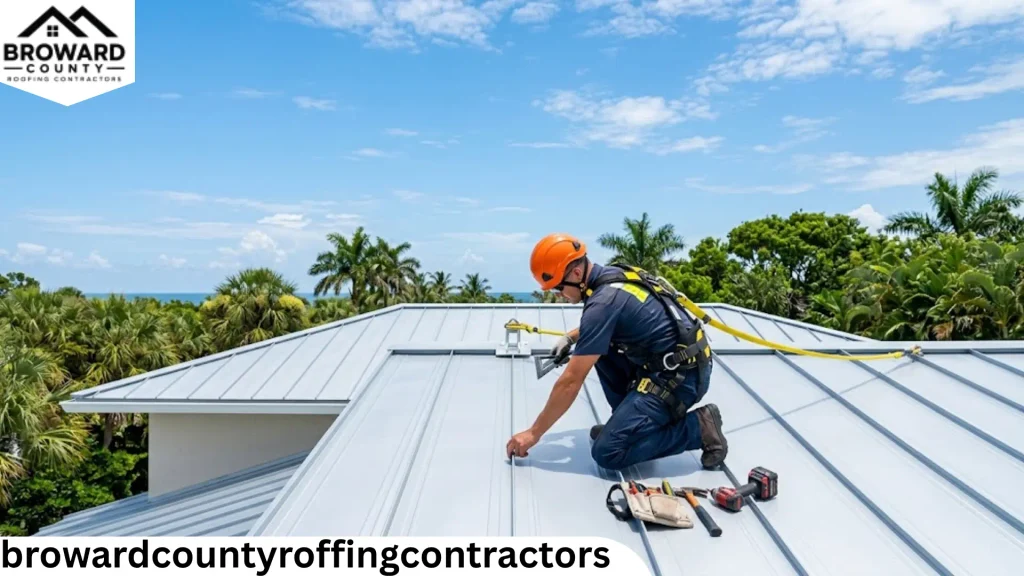
On the roof we work in a pattern. Fasteners along each panel run. Sealed joints at the ridge, walls, and penetrations. Panel surfaces in the valleys and across the flats. Every piece of flashing at every edge and transition.
When we come back down, we tell you what we found in plain language. What needs fixing now. What to watch but is not urgent. What is in good shape.
We are not the type to manufacture concerns. Our metal roof repair, coating, installation, and roof replacement services stand on their own without needing unnecessary alarm to back them up.
FAQs
How do I know if my metal roof screws need attention?
You most likely cannot tell from the ground — screws that have backed out still look fine from below. The only reliable way is having someone physically check each fastener run on the roof.
My metal roof is only five years old. Does it really need checking already?
Yes, because sealant and fastener washers start reacting to South Florida heat from day one. Catching small issues at five years costs very little compared to dealing with water damage.
Can branches from nearby trees actually damage a metal roof?
The scratches on the surface of the paint as a result of friction of the branches on the roof on windy days cause the surface rusting. Therefore, it is advisable to trim the hanging branches.
What is a roof coating for metal roofs?
Roof coating is an additional coating that is added to the old roof to prevent leaks and cover places with thin coating.
What is the real cost of skipping yearly maintenance?
It shows up later as ceiling repairs, attic moisture damage, or decking issues — all of which cost more than several years of maintenance visits combined.
How soon before storm season should we book a visit?
Six to eight weeks ahead is ideal so there is time for the inspection and any repair work before heavy rain arrives. Once storm season conversations start, booking slots across Broward County fill up quickly.
Broward County Roofing Contractors — Metal Roof Inspection, Repair, Coating, Installation, and Replacement. Serving all of Broward County. Call us to schedule a free roof assessment.